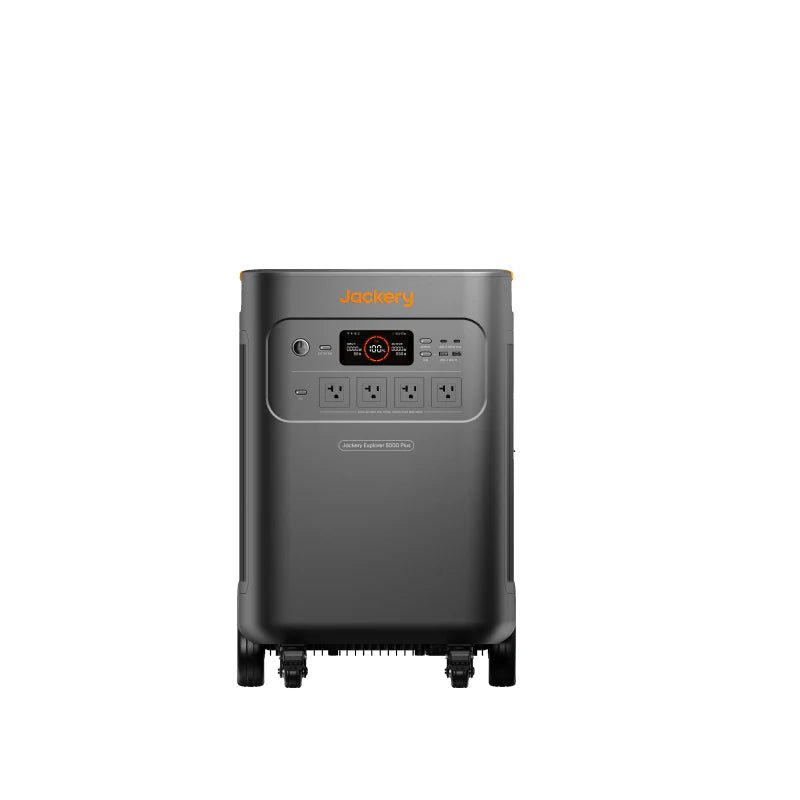
At a glance
The Jackery Explorer 5000 Plus is the base power station behind Jackery’s larger 5000 Plus home backup ecosystem. This guide is for buyers considering the standalone unit first, without solar panels, a Smart Transfer Switch, or extra expansion batteries included.
Our practical verdictBuy the standalone Explorer 5000 Plus if you want the powerful core battery and inverter first, then may add solar charging, circuit integration, or extra capacity later. Skip it if you need a complete installed home backup system on day one.
Check latest Jackery price Compare home backup options
Standalone high-output power station for essential home backup, direct appliance power and phased system expansion.
Current price: Check current offer Standalone unit, not a solar generator bundle.
Battery capacity 5040Wh
AC output 7200W rated
Surge output 14,400W
Voltage support 120V and 240V
Battery chemistry LiFePO4
Weight About 134.5 lb
Buying decision
Buy it if your outage problem is serious
- You want a battery system that can handle more than phones, laptops and LED lights.
- You need high output for appliances with startup surges, pumps, refrigerators, freezers or work equipment.
- You want 120V and 240V support from the core power station.
- You prefer a quiet, indoor-friendly battery alternative to a gas generator.
- You want to start with the base unit and add solar, transfer equipment or battery expansion later.
Do not buy it if the need is simple
- You only need backup for phones, tablets, lights, a router and one laptop.
- You want a lightweight camping power station that one person can easily carry.
- You expect automatic circuit backup without buying transfer equipment.
- You expect long runtime for heavy heating or air-conditioning loads from one 5040Wh battery.
- You need the lowest possible upfront cost and do not care about 240V support or expansion.
Calculated runtime
| Average load | Estimated runtime |
|---|---|
| 50W | 68.5 hours |
| 200W | 17.1 hours |
| 1,000W | 3.4 hours |
Calculations use 85% delivery efficiency and a 20% reserve. They are not measured results. Low-load overhead, temperature, battery age and cycling behavior can change runtime. Check starting power and individual-port limits separately.
A serious home backup unit should solve load problems, not just capacity anxiety
The Explorer 5000 Plus is interesting because it combines a large 5040Wh battery with a 7200W inverter, 14,400W surge rating and 120V/240V output. That makes it much closer to a real home backup platform than a small emergency battery.
More headroom for startup surges
Many home loads do not fail because of average watts. They fail because motors, pumps and compressors need a short burst of startup power. The high surge rating is one of the main reasons to consider this class of power station.
Better for priority loads
For outages, the best use is not running everything. It is keeping the refrigerator, freezer, internet, lights, computer or other compatible appliance running while avoiding wasteful loads.
Start with the core system
The standalone unit gives you the core battery and inverter first. Later upgrades can turn it into a more complete solar or circuit-level backup setup, but those parts are separate purchases.
What you are buying, and what you are not buying
This guide covers the standalone model. The standalone Explorer 5000 Plus is the main power station. It is powerful, but it does not include every accessory needed for a complete home backup installation.
You get the core power station
The base purchase gives you the Explorer 5000 Plus battery and inverter platform. That is the expensive foundation of the system and the part that delivers the large AC output.
You do not get solar panels
The unit supports solar charging, but the standalone product is not the Solar Generator package. If your long-outage plan depends on solar, include panel cost in your budget.
You do not get circuit integration
The base unit can power devices from its outlets. If you want selected home circuits protected through your electrical panel, plan for the correct transfer equipment and qualified installation.
Use it first as a powerful plug-in backup station
The cleanest starting point is direct appliance backup: refrigerator, freezer, router, lights, laptop, workstation, sump pump or selected emergency devices. You can add solar charging, a Smart Transfer Switch or expansion batteries after you know your real outage behavior.
Use nowPlug essential loads directly into the unit during outages.
Add solar laterUseful for longer outages if panel placement and weather cooperate.
Add STS laterRelevant if you want selected circuit backup through your home panel.
Add batteries laterNeeded if 5040Wh is not enough for your load list.
What it can power during an outage
The right question is not only what it can start. The right question is what it can run long enough to matter. A 5040Wh battery can be very useful when you manage loads carefully, but it is not unlimited home power.
| Scenario | How the Explorer 5000 Plus fits | Buyer note |
|---|---|---|
| Fridge, freezer, router, lights | One of the strongest standalone use cases. The unit has enough capacity and output to support priority home loads when you avoid unnecessary appliances. | Rotate loads if needed. Do not run everything simply because the inverter can start it. |
| Home office outage | Useful for keeping a modem, router, monitor, workstation and charging devices online during work interruptions. | For equipment that requires uninterrupted power, use a manufacturer-approved backup system. Do not chain a UPS and power station unless both manufacturers explicitly support the arrangement. |
| Motor and compressor loads | The 14,400W surge rating gives more startup headroom than smaller units. | Check both running watts and startup watts. Labels and manuals matter. |
| 240V appliance planning | The 120V and 240V support is one of the reasons this product belongs in a serious home-backup category. | Connection method matters. Use appropriate outlets, cords, transfer equipment and professional help where needed. |
| Multi-day outage | The base unit can help, but multi-day backup usually needs strict load management, solar charging, generator charging or battery expansion. | Do not confuse expandable ecosystem capacity with what the standalone unit provides by itself. |
Next steps
Runtime planning shortcut: divide usable watt-hours by the average watts of your load, then leave margin for inverter losses, startup spikes, weather, battery reserve and changing appliance behavior. A 500W average load on a 5040Wh battery is not a guaranteed 10-hour real-world result.
When the base unit is enough, and when it is not
This is the main decision point. The standalone product can be a smart first purchase, but only if you understand where its job ends and where accessories begin.
| Need | Standalone Explorer 5000 Plus | What you may need later |
|---|---|---|
| Direct appliance backup | Yes. This is the simplest and most practical starting use case. | Heavy-duty extension cords, safe placement, load plan and appliance wattage checks. |
| Automatic circuit backup | No, not by itself. | Smart Transfer Switch or another approved transfer solution plus qualified installation. |
| Solar recharging | Supported, but panels are not included. | Compatible solar panels, cables, sunlight, placement space and realistic weather expectations. |
| Longer runtime | Limited to the base 5040Wh capacity before recharging. | Battery Pack 5000 Plus expansion, solar, generator charging or lower average loads. |
| Whole-home style planning | Not a complete whole-home system alone. | Load audit, selected circuits, transfer equipment, expansion batteries and electrical planning. |
Choose the Explorer 5000 Plus because of output, not because bigger always sounds better
The biggest mistake is buying by capacity alone. For home backup, the valuable part is the balance of capacity, inverter size, surge output, 120V/240V support and future expandability.
Choose 5000 Plus
When you need high output, 240V capability, serious appliance support and a path toward circuit-level backup or expansion.
Choose a mid-size station
When your outage list is mostly refrigerator, Wi-Fi, laptops, lights and smaller appliances without 240V needs.
Choose a small station
When the goal is phones, tablets, cameras, lights, a router and short emergency coverage. The 5000 Plus would be expensive overkill.
Why it works, and where buyers get disappointed
The Explorer 5000 Plus is a strong product for the right buyer. Most disappointment comes from expecting a standalone product to behave like a fully installed home battery system.
Strengths
- High 7200W rated AC output for serious home loads.
- 14,400W surge rating for startup spikes.
- 120V and 240V support.
- 5040Wh base capacity in a single power station.
- LiFePO4 battery chemistry for long-cycle use.
- Expandable ecosystem for buyers who want to build a larger setup later.
- Quiet battery operation compared with fuel-powered generators.
Trade-offs
- The standalone product does not include solar panels.
- The standalone product does not include a Smart Transfer Switch.
- At about 134.5 lb, it is movable but not casually portable.
- High-wattage appliances can drain 5040Wh quickly.
- Circuit-level backup requires extra hardware and safe installation.
- The base price is high compared with smaller emergency batteries.
The specs that matter for home backup decisions
These are the practical specs to check before deciding whether the standalone Explorer 5000 Plus is the right first purchase.
| Spec | Jackery Explorer 5000 Plus | Why it matters |
|---|---|---|
| Product type | Standalone portable power station | This is the base unit, not the Solar Generator bundle. |
| Current price | Check current offer | Check the selected configuration and current retailer offer. |
| Battery capacity | 5040Wh | Determines baseline runtime before expansion or recharging. |
| Rated AC output | 7200W | Allows larger simultaneous loads than smaller stations. |
| Surge output | 14,400W | Useful for startup spikes from motors, pumps and compressors. |
| Voltage support | 120V and 240V | Important for serious home backup and heavier appliances. |
| Battery chemistry | LiFePO4 | Check the published cycle-retention rating and operating conditions. |
| Expandable capacity | Up to 60kWh in the broader ecosystem | Do not confuse this with standalone capacity. Expansion requires extra equipment. |
| Weight | About 134.5 lb | Storage and movement planning matter before purchase. |
Answer these before buying the standalone unit
A serious home backup purchase should start with your load list, not the product page. These questions decide whether the base unit is enough.
List your essential loadsWrite down the refrigerator, freezer, sump pump, router, modem, lights, computer, security system or water equipment you truly need.
Check running watts and startup wattsDo not guess. Motors, compressors and pumps can need far more power at startup than while running.
Decide whether you need 240VIf yes, confirm the appliance, plug type, connection method and whether professional installation is required.
Choose your charging strategyWall charging before storms is simple. Solar, generator charging or battery expansion matters more for multi-day outages.
Plan safe placementAt about 134.5 lb, this is not a throw-it-anywhere unit. Choose a dry, accessible and ventilated place near the loads you plan to power.
The best buyer is a homeowner building a backup system in phases
This product makes the most sense when you want the core power station now, but you are not ready to buy the full installed setup. It gives you serious output first and leaves the door open for solar, circuit backup and battery expansion later.
Best buyerHomeowner with serious outage risk and high-output needs.
Wrong buyerSomeone who only needs phones, lights and a small router.
Best first useDirect plug-in backup for essential loads.
Best next upgradeSolar panels, STS or battery pack, depending on your outage plan.
Questions serious buyers should ask before purchasing
Is the Jackery Explorer 5000 Plus enough for home backup?
Yes, if your goal is essential-load backup and you are comfortable managing appliances manually. It is not automatically a complete whole-home backup system unless you add the proper accessories, transfer equipment and installation.
Does the standalone Explorer 5000 Plus include solar panels?
No. The standalone product is the power station only. Solar panels are separate. If you want solar included from the beginning, compare solar generator configurations instead.
Does it include a Smart Transfer Switch?
No. The standalone unit can be used directly through its outlets. The Smart Transfer Switch is separate and is relevant if you want selected circuit backup through your home electrical system.
Can it run 240V appliances?
The Explorer 5000 Plus supports 120V and 240V output. Whether it is suitable for a specific appliance depends on running watts, startup surge, plug type, connection method and installation requirements.
Can it be expanded later?
Yes. The broader 5000 Plus ecosystem supports expansion beyond the base 5040Wh capacity. Expansion requires compatible battery packs and the right setup, so plan it separately from the standalone purchase.
Is it better than a gas generator?
It can suit quiet, indoor-friendly battery backup with no fumes during operation. A gas generator may still make sense for very long outages if it is operated outdoors and fuel is stored safely.
Should I buy the standalone unit or a bundle?
Buy the standalone unit if you want the core power station first and will add accessories later. Buy a bundle if you already know you need solar panels, transfer equipment or extra battery capacity from the beginning.
powerful base unit, not a complete backup system by itself
The Jackery Explorer 5000 Plus standalone unit is a strong serious-home-backup purchase when you want the core battery and inverter first. It becomes more complete when you add the right charging method, transfer equipment and battery expansion for your actual outage plan.
Evidence and compatibility
This is a specification-based buying guide. No hands-on testing, noise measurements or delivered-capacity tests are claimed. Runtime illustrations show their assumptions and are not measured results.
Jackery’s intended-use guidance does not recommend its portable power stations for medical devices, life-support or other critical applications. A published UPS mode or a calculated runtime does not remove that restriction. For general-purpose loads, confirm the exact regional manual, port limits and operating mode.
Expansion, transfer hardware and solar panels must match the exact model. The HomePower 2000 Plus v2 uses its own v2 expansion battery; the older Battery Pack 2000 Plus is incompatible. Check the selected bundle contents, warranty conditions and current price before ordering.
Sources
Specifications can change. Verify the selected model and regional configuration before purchase.